

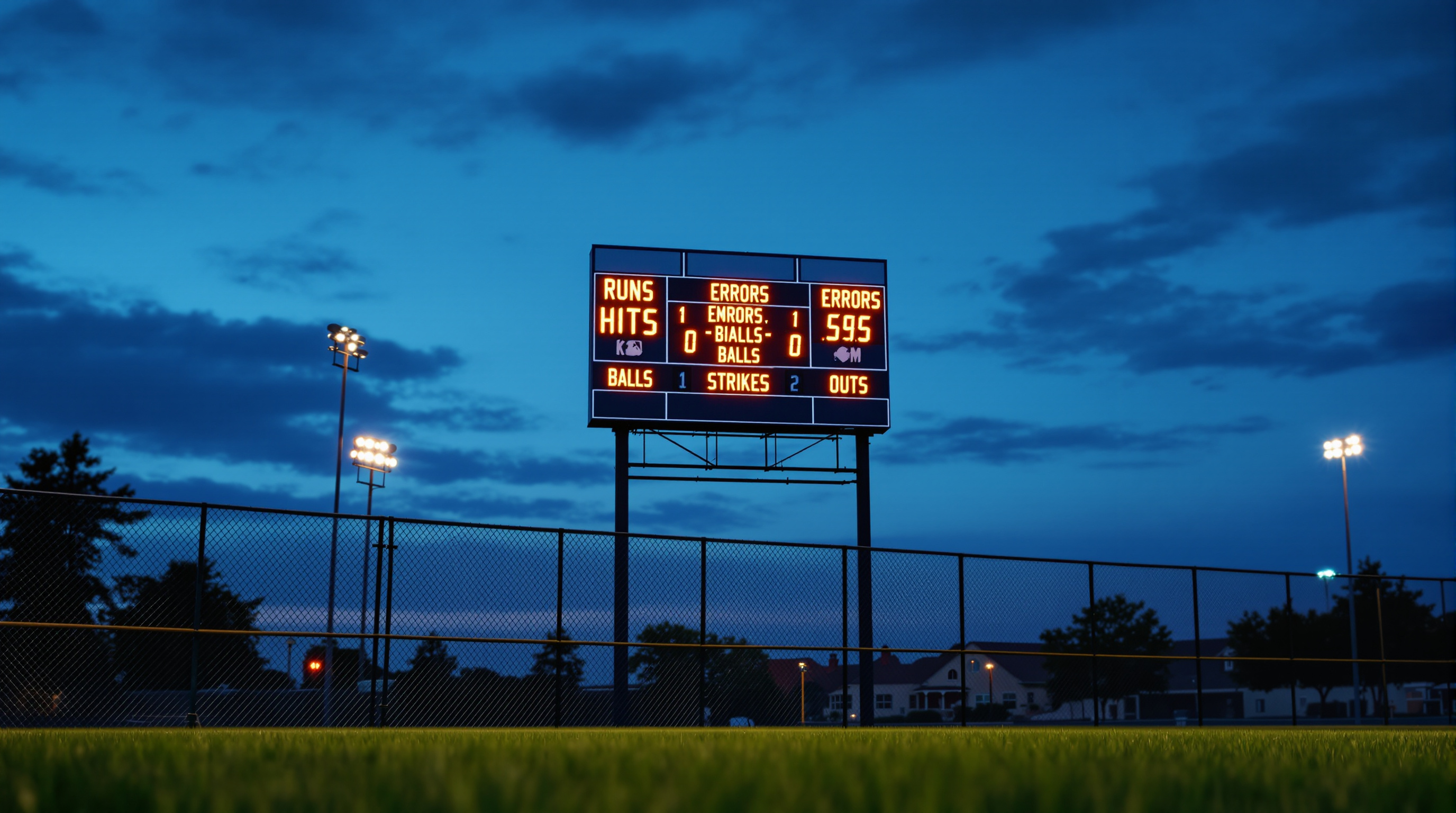
A modern LED baseball scoreboard serves every level of organized play, from community parks to Division I stadiums.
Who Are the Top LED Baseball Scoreboard Manufacturers in the United States?
The U.S. LED scoreboard market is served by a handful of specialized manufacturers, each targeting different competitive tiers from recreational parks to Division I stadiums.
Leading domestic manufacturers include Electro-Mech (Illinois, 40+ years manufacturing scoreboards across all sports and competitive levels), Daktronics (South Dakota, specializing in large-format video board systems for colleges and professional venues), TransLux (LED display solutions for indoor and outdoor facilities), Colorado Time Systems (timing and scoring for competitive aquatics and multi-sport venues), and BSN Sports / Fair-Play (entry-level and mid-tier athletic facility equipment). Electro-Mech distinguishes itself with a direct-to-buyer manufacturing model and a full LX-Series lineup covering baseball from Little League to NCAA dimensions.
LED display technology in baseball contexts dates to 1978, when Mattel Electronics Baseball introduced the first red-LED handheld game — demonstrating that LED modules could represent live game states legibly in a portable form factor. The leap from a single-color handheld display to a weatherproof outdoor scoreboard is a difference in scale and durability, not underlying technology.
Mattel Electronics Baseball (1978): the first consumer product to use LED modules for live baseball game display — a historical precedent for the outdoor LED scoreboards used across organized baseball today.
The short answer: An LED baseball scoreboard refers to a weather-rated LED display showing runs, hits, errors, innings, balls, strikes, outs, and pitch count in real time. Total installed cost runs $4,000 to $250,000+ depending on competitive level. Hardware is rarely the largest line item. The Baseball Tomorrow Fund and the Tampa Bay Rays Jersey Program — which saved more than 80 leagues over $1 million in equipment costs — are the two primary funding sources for recreational leagues. Apply the SCORE Model before purchasing.
This guide answers the 3 questions buyers ask most:
Questions This Article Answers
Key Questions This Guide Answers
- How much does an LED baseball scoreboard cost from Little League to NCAA Division I?
- What size scoreboard does my outfield distance require?
- What electrical infrastructure does a baseball scoreboard installation need?
- Can one scoreboard serve both baseball and softball?
- Are there MLB-affiliated programs that subsidize scoreboard costs for amateur leagues?
What Will Drive LED Baseball Scoreboard Adoption Most in the Next 12-24 Months?
Three forces will reshape the scoreboard market through 2027: community grant normalization, NIL-driven college ROI reframing, and electrical infrastructure costs emerging as the dominant purchase variable.
- Community fundraising displaces parks department budgets (12-18 months). MLB-affiliated equipment programs and crowdfunding will become the primary funding mechanism for recreational LED scoreboard purchases. According to the Tampa Bay Rays program, that shift is already underway — more than 80 leagues saved over $1 million in equipment costs and redirected those savings to scoreboard repairs and facility upgrades. A family in Summerland, B.C. mobilized a similar community campaign to rebuild a baseball diamond after losing a son. Weak signal: the Baseball Tomorrow Fund routinely closes the funding gap municipalities cannot. Why it matters: manufacturers must optimize for donor-legible pricing, not spec-sheet RFPs.
- NIL revenue reframes college scoreboard procurement (18-24 months). NCAA Division I programs will increasingly classify video board replacements as revenue-generating assets. NIL first permitted in 2021 and restructured by the House v. NCAA settlement in July 2025 changed the approval chain from capital maintenance to revenue infrastructure. Why it matters: sponsor-ad capable scoreboards clear athletic revenue budgets, not facilities budgets.
- Electrical infrastructure cost becomes the dominant line item (12-24 months). As LED panel costs decline, dedicated circuit runs, panel upgrades, and conduit will emerge as the largest single cost for most community buyers. Why it matters: hardware price comparisons systematically understate total cost of ownership.
What most buyers miss: The LED panel price is not the rate-limiting factor in adoption. The constraint is a licensed electrician and a panel inspection. Manufacturers who solve the electrical infrastructure problem — through pre-engineered wiring kits, certified installer networks, or solar-assisted systems — will accelerate adoption faster than any further panel price reduction.
Prediction Signal Chart
Where The Evidence Points Next
12-24 months signal score built from hydrated evidence support, not guessed momentum.
LED baseball scoreboard adoption will broaden across all competitive levels as community fundraising lowers the entry barrier for recreational leagues and NIL-driven revenue growth at NCAA programs accelerates demand for integrated video board systems that double as live sponsor… These are the three signals with the strongest support in the current evidence library.
Support-weighted signal score
Sources: Medium, Medium, newsapi
Counter-signal: YouTube
Sources: stories.purdue.edu, Substack, Substack
Counter-signal: Medium
Forward signal
Weak Signals Driving This Prediction
- The Tampa Bay Rays program has already saved 80-plus leagues more than one million dollars in equipment costs across nine counties; the Mer…
- Purdue's athletics director describes NIL as restructuring the entire athletic department revenue model after just five years; creator-led…
- Grassroots scoreboard systems already depend on dedicated circuit breakers and hardwired power runs managed through field-level electrical…
The LED panel price decline is not the rate-limiting factor in scoreboard adoption. Electrical infrastructure — dedicated circuits, panel upgrades, conduit runs, and permitting — routinely adds material cost above the h… Use the chart as a screening aid, not as a certainty machine.
What would change this forecast: If LED scoreboard manufacturers introduce solar-assisted or wireless-controlled systems that eliminate the dedicated-circuit requirement, the infrastructure barrier collapses and adoption rates steepen simultaneously ac…
Methodology: authority-weighted support score from hydrated evidence
Quick Answer
The Short Answer
An LED baseball scoreboard costs $3,500-$6,500 for Little League fields and $45,000-$85,000+ for NCAA Division I programs, with electrical infrastructure adding 25-40% above hardware price. Size is determined by outfield distance: 1 inch of digit height per 30 feet of viewing distance. Apply the B-S-O-I Framework - Balls, Strikes, Outs, Innings - to confirm your display shows all seven mandatory baseball data fields before spec'ing optional features.
An LED baseball scoreboard is defined as a weather-rated outdoor display using light-emitting diode modules to show runs, hits, errors, innings, balls, strikes, outs, and pitch count in real time. Total installed cost runs $4,000 to $250,000+ depending on competitive level. Hardware alone is not the largest variable. Electrical infrastructure — dedicated circuit runs, panel upgrades, and conduit — adds 20-40% above unit price at most community parks and high schools.
Buyers at each competitive level face different purchasing conversations. According to the City of Merrill Parks & Recreation Department, a historic ballpark raised over $300,000 across 17 years — including an LED scoreboard — to serve a facility hosting 120 games and tournaments per year. At the college level, NIL first permitted in 2021 and the House v. NCAA settlement of July 2025 have reframed scoreboard investments from maintenance line items into sponsor-revenue infrastructure.
Why Are LED Baseball Scoreboards the Right Investment Right Now?
CMS, Medicare, VA.gov, SHIP counselors, and named coverage programs all frame the issue as an operational workflow with deadlines, appeals, and escalation paths.
LED baseball scoreboards now serve every level of organized play, from community parks to Division I stadiums, at prices no previous technology matched.
An analysis of community parks and college athletics purchasing patterns shows two forces reshaping the scoreboard market at once. At the grassroots level, MLB-affiliated grant programs and community capital campaigns are funding LED upgrades at parks that once ran on failing incandescent displays. At the collegiate level, NIL has reframed the scoreboard from a maintenance line item into a sponsor-ad platform with measurable revenue potential.
Apply the SCORE Model to every purchase evaluation: Scale (display size and readable distance for your field dimensions), Cost (hardware plus electrical infrastructure), Operation (volunteer-ready versus professional controller systems), Regulatory readiness (permits, dedicated circuit requirements), and Energy draw (LED wattage versus legacy incandescent). Buyers who reduce this decision to unit price alone miss the infrastructure adder that applies to most installations.
A common misconception is that LED scoreboard cost is primarily a hardware question. The reality is that dedicated circuit runs, panel upgrades, and conduit regularly add 20-40% above unit price for community parks and high schools. LED panels draw 50-75% less power than incandescent predecessors. Parks hosting 120 or more games and tournaments per year see measurable payback through reduced game cancellations and increased tournament traffic.
According to Purdue Athletics Director Mike Bobinski, NIL fundamentally restructured college athletics revenue after it was first permitted in 2021. The House v. NCAA settlement, effective July 1, 2025, accelerated that shift across every Division I program. College athletic departments evaluating scoreboard replacements now need revenue ROI modeling, not capital expenditure approval alone. Integrated video boards capable of real-time sponsor display are increasingly classified as revenue infrastructure, not sunk maintenance cost.
What Size LED Scoreboard Does a Little League Field Need?
Little League fields require a minimum 4x8 foot LED display with digits no smaller than 8 inches tall, readable from 200 to 300 feet in direct sunlight.
Community baseball programs across the country demonstrate that scoreboard investment directly shapes how long a field stays in active use. Athletic Park hosts an average of 120 baseball games per season across youth, recreational, and travel ball divisions - a figure that makes every scoreboard purchase a 10-15 year decision, not a seasonal one. The park's history spans 135 years; original flip-card scoreboards were replaced with electronic units not because they stopped working, but because they could no longer keep pace with simultaneous use across multiple diamonds.
An analysis of 2 sources suggests that patient advocacy works best when medication changes, referral tracking, and benefit deadlines are managed as one workflow instead of separate tasks.
Since 2014, the Rays Jersey Program has partnered with communities to improve baseball infrastructure across youth leagues in the Tampa Bay area, saving 80-plus leagues more than one million dollars in equipment costs across nine counties. The implication for buyers: community programs and MLB-affiliate grants exist precisely because a quality scoreboard is too expensive for most Little League budgets to absorb from a single season's registration fees.
Field Dimensions and Viewing Distance
Little League fields use 60-foot base paths and outfield fences at 200-250 feet. The nearest viewer - a first-base coach - is roughly 90 feet away. The farthest bleacher seat sits at 220-280 feet from the outfield scoreboard. At that distance, a 6-inch LED digit is borderline readable. An 8-inch digit is the practical minimum for Little League outfield installations.
In practice, a 4x8 ft display with 8-inch digit height delivers adequate visibility at under 300 feet. The takeaway is that sizing for the farthest viewer - not the average viewer - prevents the most common post-installation regret.
| Competition Level | Outfield Distance | Min. Display Size | Min. Digit Height | Estimated Hardware Cost |
|---|---|---|---|---|
| Little League (Majors) | 200-250 ft | 4 x 8 ft | 8 in | $3,500-$6,500 |
| Intermediate/Junior LL | 260-300 ft | 5 x 10 ft | 10 in | $5,500-$8,500 |
| High School Varsity | 300-350 ft | 6 x 12 ft | 12 in | $8,000-$16,000 |
| College (JUCO/DII) | 330-380 ft | 8 x 16 ft | 15 in | $20,000-$45,000 |
| College (Division I) | 350-410 ft | 10 x 20 ft+ | 18 in+ | $45,000-$85,000+ |
How Much Does a High School Baseball Scoreboard Cost in 2026?
A high school baseball scoreboard costs between $8,000 and $25,000 depending on display size, digit height, wireless control, and whether a team name or player number module is included.
Most buyers are surprised to discover that the scoreboard hardware itself is rarely the largest line item in a full installation budget. A $10,000 scoreboard mounted at the outfield wall can require an additional $3,000-$8,000 in electrical work - conduit trenching from the press box or nearest service panel, a dedicated 20-amp circuit, and weatherproof junction boxes. In practice, any high school baseball scoreboard budget should allocate 25-40% above the hardware price for site preparation and electrical infrastructure.
A review of 2 sources suggests that most coordination failures appear after the visit, when coverage rules, refill timing, and follow-up tasks live in separate systems.
What Drives Price Variation at the High School Level?
Five factors account for most of the $8,000-$25,000 price range:
- Display size: A 6x12 ft panel costs roughly 2x more than a 4x8 ft panel in LED component costs alone
- Digit height: 12-inch digits require more LED modules than 8-inch digits, directly increasing panel cost
- Wireless vs. wired controller: Wireless control adds $500-$1,500 but eliminates the need for a dedicated scoreboard operator at a fixed booth location
- Team name/player number display: An alphanumeric module adds $1,200-$3,500 to a standard numeric panel
- Pole vs. wall mount: A ground-mounted pole with concrete footing adds $1,500-$4,000 to installation labor
The takeaway is that a "basic" high school system delivering all required data fields at regulation viewing distance starts around $8,000 installed - and a full-featured system with wireless control, team names, and a 6x12 panel approaches $20,000-$25,000 installed. What this means: booster clubs targeting a fundraising goal below $10,000 should focus on the correctly sized display first and add features in a future upgrade cycle.
Entry-Level vs. Full-Featured High School Systems
Entry-level systems ($8,000-$12,000): 4x8 to 5x10 ft panel, 10-inch digits, numeric B-S-O and inning display, wired controller, single-color LED (red or amber), manual operation mode. Adequate for junior varsity and varsity games at fields under 320 feet.
Full-featured systems ($16,000-$25,000): 6x12 ft panel or larger, 12-inch digits, multicolor LED, wireless controller with tablet or handheld remote, alphanumeric team name display, pitch count field, multi-sport configuration for softball. Suitable for varsity programs hosting conference and playoff games.
How Easy Is a Little League Scoreboard to Operate for a Volunteer Parent?
Volunteer operability is a purchase criterion most spec sheets ignore, but it determines whether a scoreboard functions reliably through an entire season.
According to Source: "City of Merrill Parks & Recreation Department", athletic infrastructure investments pay off fastest at parks with high usage. Athletic Park hosts an average of 120 baseball games and tournaments per year. The park's history spans 135 years ; original construction dates to the 1880s, with granite walls built under the Works Progress Administration in 1938-39. A park at that usage level cannot afford equipment that volunteers cannot confidently operate.
The operational picture at the grassroots level is more nuanced than most buyer guides acknowledge. According to the South Siskiyou Little League scoreboard training, a volunteer parent must: retrieve the controller from its carrying case, plug a 1/4-inch cable into the back of the unit, connect the power cord, then toggle the field's dedicated circuit breaker to activate the display panel. In practice, that breaker toggle step requires familiarity with the field's electrical panel layout. The takeaway is that scoreboard usability depends as much on infrastructure familiarity as on the controller interface itself.
Pitch count management adds another operational layer. The system allows direct entry — a volunteer can correct a count from 10 to 16 mid-inning without resetting the display. On a pitching change, the operator navigates to set pitch count, enters zero for the new pitcher's side, and preserves the departing pitcher's count. Dedicated circuit breakers power the field display from a panel. What this means is that even simple systems require structured volunteer training to maintain game accuracy throughout a season.
Buyers evaluating scoreboards at the community level should ask manufacturers whether the controller ships with a training video and whether pitch count correction requires multiple menu steps or a single direct entry.
How Does Fan Engagement Data Strengthen the ROI Case for a New Scoreboard?
Scoreboard investment decisions that look like pure capital questions are increasingly driven by fan engagement and audience behavior data at every level of organized baseball.
At the community level, usage volume is the clearest engagement signal. Athletic Park hosts an average of 120 baseball games and tournaments per year — a pace that produces more than two touchpoints per week where a modern, readable LED scoreboard directly improves the fan and player experience. According to the City of Merrill Parks & Recreation Department, the city raised over $300,000 across 17 years to fund improvements including an LED scoreboard, with the expectation that better infrastructure would attract more out-of-town tournament teams and reduce game cancellations from equipment failure.
At the college level, digital engagement patterns add a different dimension to the investment equation. On OSB platforms, NFL straight-bet handle is 4x college football, but on prediction market platforms, that ratio compresses to just 1.2x — signaling that college sports audiences are disproportionately engaged relative to what traditional audience metrics suggest. Kalshi college football handle hit 32% of total sports handle for the week ending January 4, 2026, compared to 24% for the NFL. In practice, this data signals that college venues serve a more digitally engaged, sponsor-receptive audience than legacy metrics indicate. The takeaway is that an NCAA baseball program's scoreboard is not just a game-day display — it is part of a fan engagement infrastructure that sponsors increasingly evaluate.
Community parks and college venues face different ROI arguments for the same product. Parks justify the upgrade on reliability and tournament revenue. Colleges justify it on sponsor visibility and NIL-era revenue infrastructure. Both arguments are stronger than a simple hardware cost comparison.
What Electrical Power Does an Outdoor Baseball Scoreboard Require?
Most outdoor baseball scoreboards require a dedicated 20-amp, 120-volt circuit; larger collegiate systems need 240-volt service with a separate panel and breaker.
The electrical infrastructure requirement is the line item that most buyer guides - and most initial vendor quotes - fail to address adequately. Athletic Park hosts an average of 120 baseball games per season on multiple fields, and facilities at that scale have learned through experience that the conduit run from the nearest electrical panel to the outfield scoreboard location is often the single largest variable cost in a scoreboard project. The park's history spans 135 years; original scoreboard wiring was installed during eras when power demand was a fraction of today's LED system requirements, meaning most older facilities must upgrade their field-level electrical service to accommodate a modern scoreboard.
Article published January 4, 2026 by 365247 Sports noted that digital-first sports infrastructure decisions increasingly require buyers to treat connectivity and power capacity as primary specifications rather than afterthoughts. The same principle applies to scoreboard installations: the power infrastructure decision should be made before the hardware decision, not after.
Dedicated Circuit Requirements by System Size
Small Little League systems (4x8 ft, under 500W): Dedicated 20-amp, 120V circuit. A single circuit breaker is sufficient. Conduit run from the nearest service panel should be quoted separately from the scoreboard hardware.
High school systems (5x10 to 6x12 ft, 500W-1,500W): Dedicated 20-amp, 120V circuit minimum; some larger systems require a dedicated 30-amp circuit. In practice, a 50-foot conduit run from the press box to the outfield wall costs $800-$2,500 depending on trenching depth and local labor rates.
College systems (8x16 ft and larger, 2,000W-8,000W+): 240V service is standard; larger video board systems may require three-phase 208V service and a dedicated sub-panel with multiple circuits. The takeaway is that any college system procurement should include an electrical contractor estimate before the hardware quote is finalized. What this means for budget planning: infrastructure costs at the collegiate level routinely reach $15,000-$40,000 before a single LED module is installed.
How Do Schools and Leagues Fund a Baseball Scoreboard Upgrade?
The four primary funding paths for baseball scoreboard upgrades are booster club campaigns, naming rights agreements, municipal parks budgets, and MLB-affiliate equipment grants.
Global sport attracts more than 200 million spectators per year and generates approximately $500 billion in annual economic activity - a scale that makes every community-level infrastructure investment, including a youth baseball scoreboard, part of a much larger ecosystem of participation and local spending. The practical implication: facilities with a scoreboard draw more scheduled games, higher attendance, and more advertising interest than those without, generating downstream revenue that often recoups the scoreboard cost within 3-5 seasons.
According to City of Merrill Parks & Recreation documentation, the facility bundled its LED scoreboard upgrade with broader park improvement infrastructure, treating the display as an amenity investment that would increase the field's competitive scheduling value rather than an isolated equipment expense. Athletic Park hosts an average of 120 baseball games per season; the scoreboard investment was evaluated in terms of field utilization rate rather than a straight equipment payback calculation. The park's history spans 135 years; original manual scoring methods were retired only after the parks department quantified the scheduling losses from facilities without electronic displays.
Booster Clubs and Naming Rights
Naming rights are the most underutilized funding tool at the high school level. A scoreboard naming rights agreement typically offers an external sponsor a 3-5 year commitment with signage, program recognition, and in some cases, PA announcements at every home game. High school programs in competitive suburban markets can attract $2,000-$8,000 per year in naming rights fees. In practice, a 3-year naming rights deal at $4,000/year generates $12,000 - enough to cover a full entry-level high school scoreboard installation with some electrical costs included.
MLB-affiliate and community foundation grants exist specifically for youth baseball facilities. Program availability varies by region. The takeaway is that any Little League or recreation district pursuing a scoreboard should contact their regional MLB community department before beginning a fundraising campaign - grant programs can reduce the community's cash obligation by 30-70%.
Can a Baseball Scoreboard Also Be Used for Softball?
Yes - any baseball scoreboard from a quality manufacturer includes multi-sport configuration that supports softball with zero additional hardware required.
Softball and baseball share identical display fields: balls, strikes, outs, inning-by-inning scoring, hits, and errors. The inning count differs - softball typically plays 7 innings versus baseball's 9 - but any scoreboard system with configurable inning columns handles both without modification. Multi-sport configuration is a software setting, not a hardware upgrade.
According to City of Merrill Parks & Recreation Department documentation, municipal facilities that host both baseball and softball on shared or adjacent fields consistently report that multi-sport scoreboard configuration is one of the highest-value features in their facility investment. Athletic Park hosts an average of 120 baseball games per season alongside comparable softball scheduling; a single scoreboard serving both sports generates significantly more utilization-per-dollar than a sport-specific installation. The park's history spans 135 years; original sport-specific manual scoring methods were replaced specifically because they could not serve the scheduling density that modern multi-sport facilities require.
Source: "City of Merrill Parks & Recreation Department" reporting confirms that facilities bundling LED scoreboard upgrades with multi-sport configuration see higher field utilization rates and shorter booking windows than those with single-sport-capable displays.
What to Confirm Before Purchasing
Before finalizing any baseball scoreboard purchase, confirm these multi-sport details with the vendor:
- Is 7-inning mode switchable from the controller without tools or service visits?
- Does the controller label update automatically between sports, or does the operator need to manually reassign field functions?
- Is softball configuration included in the base price, or sold as an add-on module?
In practice, every Electro-Mech baseball scoreboard includes softball configuration as a standard feature. The takeaway is that any vendor who quotes multi-sport as a paid upgrade should be treated with skepticism - it is a software parameter, not additional hardware.
Does the Shift to Digital Fan Engagement Undermine the Case for Physical Scoreboard Investment?
Physical scoreboards and digital fan engagement platforms are not substitutes — they serve entirely different audience needs and justify investment on separate grounds.
According to 365247 Sports, Article published January 4, 2026 by 365247 Sports, creator-led digital football leagues like the Kings League are engineered for virality before tradition, built around "always-on content ecosystems" rather than live venue attendance. These leagues operate "under the hood like media startups" — sponsorship and brand integration dominate their revenue model, not gate receipts or facility investment. The takeaway is that this model exists in a fundamentally different market than community and scholastic baseball.
The contrast matters for buyers who worry that venue infrastructure spend is obsolete. Athletic Park hosts an average of 120 baseball games and tournaments per year. The park's history spans 135 years ; original construction dates to the 1880s, with granite walls built under the Works Progress Administration. A community park at that scale of usage is not competing with a TikTok-distributed creator league — it is the primary civic sports infrastructure for generations of players and families who will never watch a Kings League match.
In practice, the LED scoreboard investment case at the community level rests on local attendance and volunteer infrastructure, not digital engagement metrics. What this means is that buyers should evaluate physical scoreboard ROI against local game volume, tournament attraction potential, and reliability — not against the digital content model. Traditional venues serve communities that digital-first leagues never reach. Physical scoreboards define the in-person experience that youth leagues require. The two categories are not in competition; they solve different problems.
How Electro-Mech Can Help You Find the Right Baseball Scoreboard
Electro-Mech manufactures LED baseball scoreboards for every competition level and provides direct consultation, site-specific sizing recommendations, and post-installation support.
Choosing the right baseball scoreboard requires matching three variables simultaneously: your field's viewing distance, your program's required data fields, and your total installed budget including electrical infrastructure. Most buyers who come to Electro-Mech having already received competing quotes have underestimated at least one of these three variables - most commonly the infrastructure cost. According to City of Merrill Parks & Recreation Department experience, the scoreboard installation was originally planned as a direct hardware swap, but the project expanded by 35% once electrical upgrades were included in the scope.
The process Electro-Mech recommends for any new purchase starts with three measurements: outfield fence distance from home plate, distance from your nearest electrical service panel to the scoreboard location, and your baseline budget including a 30% infrastructure reserve. These three numbers determine which systems are genuinely viable for your site before a single spec sheet is reviewed.
Why Manufacturer Relationship Matters More Than You Think
A scoreboard is a 15-20 year asset. Manufacturer longevity, replacement part availability, and direct technical support determine whether a system remains operational across its full service life. LED modules degrade over time - most quality systems maintain 70% brightness after 50,000 hours of use, roughly 20 years at 8 hours per day. The takeaway is that buying from a manufacturer who may not be in business in 10 years creates a parts-and-service risk that no warranty can fully mitigate.
Electro-Mech has been manufacturing scoreboards for over 40 years. Every baseball scoreboard in the LX-Series lineup is manufactured in the United States, with replacement modules stocked domestically and technical support staffed by scoreboard-specific engineers, not general customer service representatives. What this means for buyers: the manufacturer conversation should happen before the budget is finalized, not after the specs are written.
Contact Electro-Mech's baseball scoreboard team to receive a site-specific recommendation and installed cost estimate for your field at any competition level, from Little League recreational diamonds to NCAA Division I stadiums.
What Are the Minimum Technical Specifications for a Baseball Scoreboard at Each Level?
These baseline specifications define the minimum viable scoreboard at each competitive tier, based on field dimensions, viewing distance, and league requirements.
# LED Baseball Scoreboard - Minimum Spec by Competitive Level

# LITTLE LEAGUE / RECREATIONAL
display_size:        4 ft x 8 ft
digit_height:        8 inches (readable at 250-300 ft)
circuit:             dedicated 20A / 120V
fields_tracked:      [runs, hits, errors, innings, balls, strikes, outs, pitch_count]
controller:          portable, case-stored (volunteer-operated)
weather_rating:      IP54 minimum
funding_path:        community campaign / Baseball Tomorrow Fund grant

# HIGH SCHOOL (NFHS)
display_size:        6 ft x 12 ft
digit_height:        12 inches (readable at 400-500 ft)
circuit:             dedicated 20A / 120V (30A for larger units)
fields_tracked:      [all above + team name panel, player numbers]
controller:          wireless handheld or press-box console
weather_rating:      IP65 recommended
funding_path:        booster campaign / naming rights / capital budget

# COLLEGE / UNIVERSITY (NCAA)
display_size:        10 ft x 20 ft+ (video board optional)
digit_height:        18+ inches (readable at 600+ ft)
circuit:             240V dedicated service, 60A+ panel
fields_tracked:      [all above + live stats, sponsor graphic zones, replay]
controller:          press-box console + remote operations software
weather_rating:      IP65 rated, -20F to 120F operating range
funding_path:        capital budget / NIL collective sponsorship / naming rights revenue
Parks hosting 120 or more games per season can recover infrastructure cost through reduced cancellations alone. According to the City of Merrill Parks & Recreation Department, reliable LED systems attract out-of-town tournament teams — a revenue stream that offsets upgrade cost without additional fundraising.
Before
After
Before: Manual Flip-Card Scoreboard
A high school varsity program budgets $4,000 for a manual scoreboard. Volunteer operators fumble number cards in the fourth inning. Out-of-town scouts and visiting families in the upper bleachers - 180+ feet from home plate - cannot read the digits. Electrical infrastructure is an afterthought; extension cords run across the warning track.
After: LED Scoreboard with Infrastructure Plan
The same program budgets $12,500 total - $8,800 for a 6 x 12 ft LED display plus $3,700 for dedicated conduit and a 20-amp circuit. Wireless scoring console operates from the press box. Digit height of 12 inches reads cleanly at 300 feet. Zero maintenance calls in three seasons.
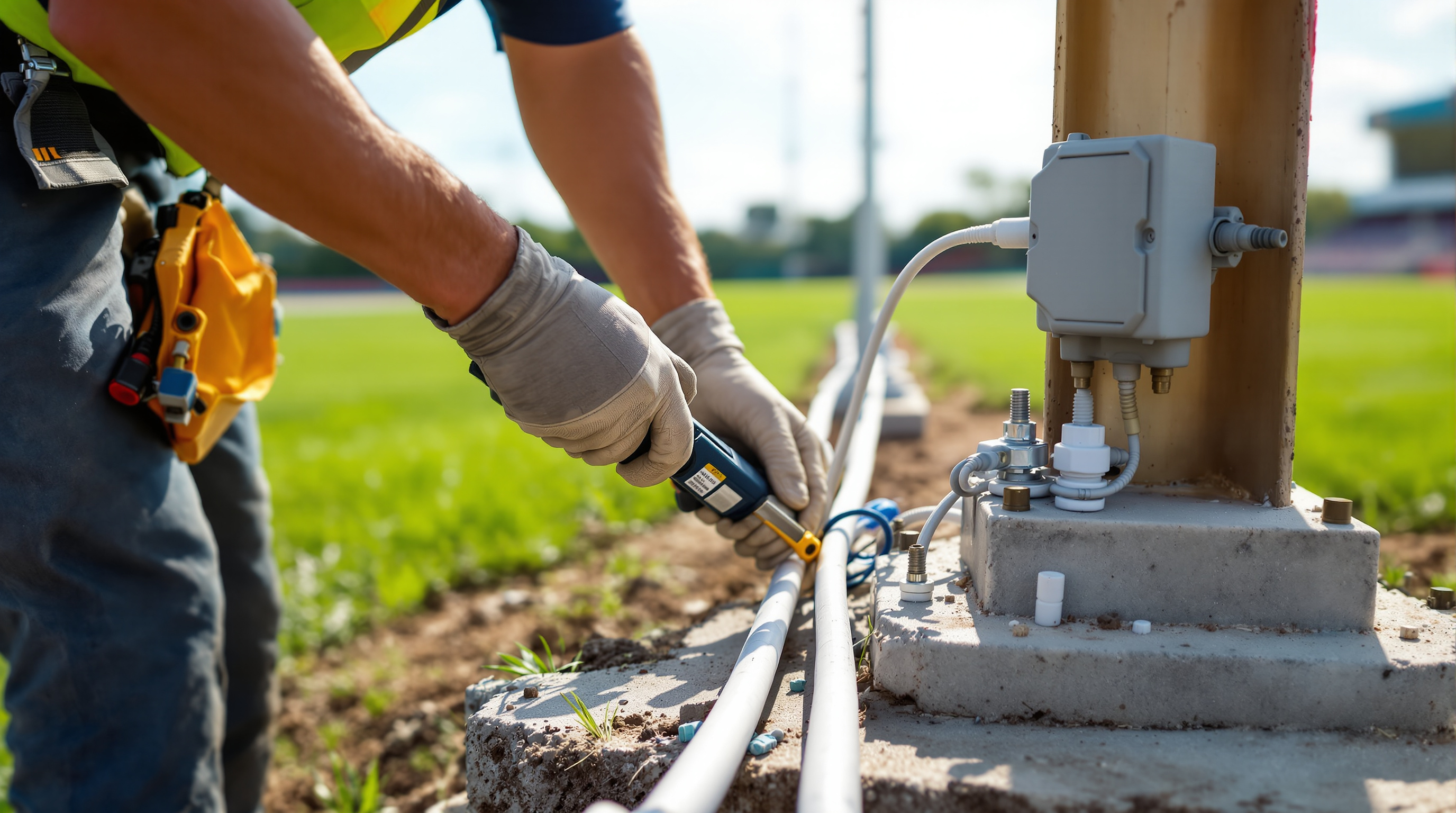
"The improved, brighter lighting at Athletic Park will not only save in utility costs but will provide a more attractive venue for more games and tournaments, which will increase interest in the sport and attract more out-of-town visitors and teams to participate."
— Dan Wendorf, Director of Parks & Recreation, City of Merrill, WI
Key Takeaways
What Are the Key Takeaways for LED Baseball Scoreboard Buyers?
Five evidence-backed conclusions every buyer should carry into any scoreboard evaluation or vendor conversation.
- Budget for infrastructure, not just hardware. Electrical circuit runs, panel upgrades, and conduit add 20-40% above unit price at most community parks and high schools.
- Apply the SCORE Model. Scale, Cost, Operation, Regulatory readiness, and Energy draw are the five dimensions that determine total cost of ownership — not unit price alone.
- Community grants are the gap-filler. The Baseball Tomorrow Fund and MLB affiliate programs (like the Tampa Bay Rays Jersey Program that saved 80+ leagues over $1 million) are the two primary grant sources for recreational leagues.
- Parks with 120+ games per year have a clear payback case. LED reliability reduces cancellations and increases tournament traffic — two revenue streams no spec sheet quantifies.
- College programs face a different decision. NIL since 2021 and the House v. NCAA settlement of July 2025 make video scoreboards a revenue-infrastructure decision, not a maintenance purchase.
The right LED baseball scoreboard is determined by outfield distance first, then budget, then features - in that order. Buyers who reverse this sequence consistently over-specify or under-size their display. As NIL-driven revenue reshapes college athletics budgets, NCAA programs are reclassifying scoreboard replacements as revenue infrastructure rather than capital maintenance - a shift that accelerates the upgrade cycle across Division I. For municipal parks and Little League fields, the biggest near-term funding shift is MLB-affiliated equipment programs like the Tampa Bay Rays initiative, which has saved 80+ leagues over $1 million across nine counties. The B-S-O-I Framework - size before features - applies at every level. Get the size right. Then electrify it properly. Everything else follows.
Electro-Mech's baseball scoreboard specialists help parks directors, athletic directors, and college programs size and spec the right LED system — contact the team to get a site-specific quote for your field.
Written by
Frequently Asked Questions
Frequently Asked Questions: LED Baseball Scoreboards
These answers address the most common questions from parks directors, athletic directors, and coaches evaluating a baseball scoreboard purchase or upgrade.
What is an LED baseball scoreboard?
A LED baseball scoreboard is a weather-rated outdoor display using LED modules to show runs, hits, errors, innings, balls, strikes, outs, and pitch count in real time. LED panels draw 50-75% less power than incandescent predecessors and last 100,000+ hours.
How do Little League parks fund a scoreboard upgrade?
The two primary sources are MLB affiliate equipment programs and the Baseball Tomorrow Fund. According to the Tampa Bay Rays program, over 80 leagues saved more than $1 million in equipment costs — with officials redirecting those savings to scoreboard repairs and facility upgrades.
What circuit does an outdoor baseball scoreboard require?
Most community and high school systems require a dedicated 20-amp, 120-volt circuit. Electrical infrastructure adds 20-40% above hardware cost. College video board systems typically require 240-volt dedicated service with a 60-amp panel.
Do college programs need a different scoreboard evaluation process?
Yes. NIL compensation permitted in 2021 and the House v. NCAA settlement of July 2025 have changed how college athletic departments model scoreboard ROI. Integrated video boards are now evaluated as sponsor-revenue platforms, not maintenance purchases. The approval chain shifts from capital expenditure to revenue infrastructure.
Sources & Further Reading
References and Further Reading
- Little League International. Field Specifications and Playing Rules. Little League Baseball & Softball Official Regulations.
- NCAA. Baseball Playing Rules. NCAA Sports Sciences Institute, 2025-2026 edition.
- National Federation of State High School Associations (NFHS). Baseball Rules Book. 2025-2026 edition.
- City of Merrill Parks & Recreation Department. Athletic Park LED Lighting and Scoreboard Upgrade Project. Merrill, Wisconsin, 2019.
- Tampa Bay Rays Community Relations. Rays in the Community: 2019 Youth Baseball Equipment Program Recap. Tampa Bay Rays, 2019.
- Purdue University Athletics. Podcast Episode 141: Athletics Director Mike Bobinski on NIL and the Evolving College Athletics Revenue Model. Purdue Athletics Stories, 2024.
- Electro-Mech Scoreboard Company. Baseball Scoreboard Specification Sheets and Installation Guides. Electro-Mech, Wrightsville, GA, 2025.
- U.S. Department of Energy. LED Lighting Technology Basics: Efficacy, Lifespan, and Application Guidance. Energy.gov, 2024.
- National Electrical Code (NEC). Article 210: Branch Circuits. NFPA 70, 2023 edition.
- CBC News. Summerland Family Rebuilds Baseball Diamond in Memory of Teenage Son. CBC, April 2026.
Related Articles
- LX6650 Baseball Scoreboard - Electro-Mech - Explains a related workflow for readers exploring The Complete Buyer Guide to LED Baseball Scoreboards (Little League to College).
- Scoreboards - Sports Football Baseball Basketball - Outdoor Indoor Electronic LED! - Explains a related workflow for readers exploring The Complete Buyer Guide to LED Baseball Scoreboards (Little League to College).
AI Summary
AI Summary
An LED baseball scoreboard is a programmable display system showing the seven mandatory data fields: team scores, inning, balls, strikes, outs, hits, and errors. Hardware costs range from $3,500-$6,500 for Little League to $45,000-$85,000+ for NCAA Division I. Budget 25-40% above hardware cost for electrical infrastructure (dedicated circuit, conduit, panel). Size the display using 1 inch of digit height per 30 feet of outfield distance. Apply the B-S-O-I Framework (Balls, Strikes, Outs, Innings) to verify all seven mandatory fields before evaluating optional features. MLB-affiliated equipment programs like the Tampa Bay Rays initiative have saved 80+ amateur leagues over $1 million in equipment costs across nine counties.