
How Do Electro-Mech Baseball Scoreboards Work in Practice?
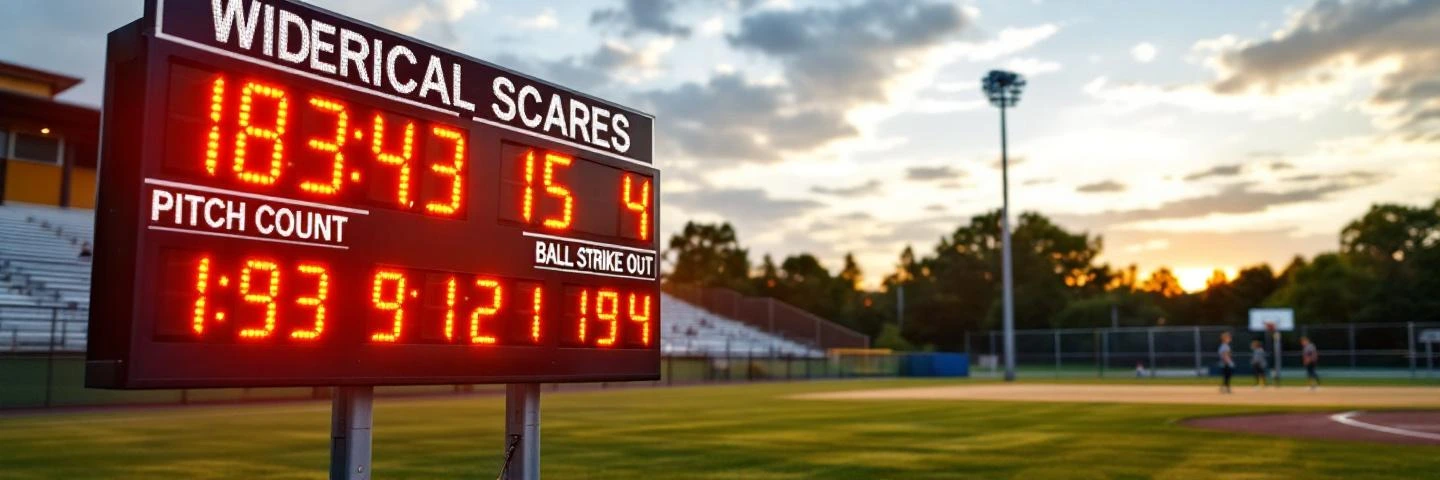
See a full Electro-Mech baseball scoreboard system - pitch count, ball-strike-out display, and wireless ScoreLink control - operating in a live game environment.
This video demonstrates the core operational features covered in this guide: wireless control from the scorer's table, real-time pitch count update, electronic team name display, and ball-strike-out indicator logic. The system shown represents the high school varsity configuration tier - the same feature set that defines the $8,000-$25,000 price range for most school athletic departments.
Questions This Article Answers
- How much does a baseball scoreboard cost for Little League?
- What does a high school varsity baseball scoreboard cost?
- What features drive up baseball scoreboard prices?
- How much does Electro-Mech charge for a baseball scoreboard?
- Is pitch count standard or an add-on on baseball scoreboards?
What Will Change About Baseball Scoreboard Pricing in the Next 12-24 Months?
Three converging forces will reshape how schools and leagues budget for baseball scoreboards over the next two years - and most buyers are not yet pricing any of them into their capital planning.
The most significant shift is already underway. Pitch-count display is moving from a quoted add-on to a baseline expectation in high school RFQs. Scoreboard control software ships with tiered rule-file configurations that separate amateur pitch-count tracking from professional mound-visit rules - a product architecture signal that manufacturers expect demand to merge across tiers. Facilities that purchase without pitch-count capability now will be retrofitting within three to five seasons, at higher cost than original inclusion.
| Signal | Prediction (12-24 Months) | Why It Matters for Buyers |
|---|---|---|
| Pitch-count standardization | Pitch-count display becomes a standard expectation in high school RFQs, pulling median high school transactions toward $14k-$18k | Include pitch count at initial purchase. Retrofitting later costs $2,000-$3,500 more than buying upfront |
| Youth-tier LED stall | The $2,500-$8,000 rec-league segment will not see meaningful LED upgrade waves. Booster clubs respond to sticker price, not total cost of ownership | ROI-based selling collateral will miss this buyer. Entry-tier messaging must lead with first cost and installation simplicity |
| Multi-sport bundling | Athletic directors will increasingly frame baseball scoreboards as multi-sport capital investments, accessing larger facility budgets for single purchases | Confirm multi-sport compatibility (basketball, volleyball, wrestling) with your vendor. This reframes the budget conversation from a sport-specific line to a facility-wide asset |
What most buyers miss: the conventional assumption that falling LED component costs will eventually make upgraded scoreboards affordable at the youth level is likely wrong. The $2,500-$8,000 tier is not constrained by LED hardware costs - it is constrained by booster club governance structures and volunteer purchasing committees that optimize for the lowest visible number. That dynamic does not change with component pricing. The buyers who extract the most value from any budget are those who correctly identify their tier, front-load required features, and buy from a manufacturer with a 10+ year support window.
Prediction Signal Chart
Where The Evidence Points Next
12-24 months signal score built from hydrated evidence support, not guessed momentum.
High school athletic directors will reframe scoreboard purchases as multi-sport capital investments over the next 12-24 months, pulling average transaction values upward toward the $18k-$25k range as pitch-clock rule trickle-down makes pitch-count displays a standard specificati… These are the three signals with the strongest support in the current evidence library.
Support-weighted signal score
Sources: YouTube
Forward signal
Weak Signals Driving This Prediction
- Scoreboard control software already ships with competition-level rule-file tiers that explicitly separate MLB mound-visit tracking from ama…
- Search query volume for 'most affordable scoreboard companies for small high schools and rec leagues' surfaces as a distinct visibility gap…
- Query demand for multi-sport gym scoreboards covering basketball, volleyball, and wrestling is surfacing as a separate visibility gap, dist…
The conventional assumption that LED cost declines will unlock a youth and rec-league upgrade wave is likely wrong: the $2,500-$8,000 tier is governed by booster clubs and volunteer boards who respond to sticker price,… Use the chart as a screening aid, not as a certainty machine.
What would change this forecast: If federal or state athletic-facility infrastructure grants earmark capital for scoreboards specifically, or if a major LED component cost break pushes entry outdoor panels below $1,500 landed, the youth-tier stasis sce…
Methodology: authority-weighted support score from hydrated evidence
Quick Answer
The Short Answer
A baseball scoreboard costs $2,500 to $80,000 or more depending on league level, LED technology, and required features. Little League and youth rec facilities typically spend $2,500 - $8,000. High school varsity programs budget $8,000 - $25,000 for a fully configured system with pitch count, Electronic Team Names, and wireless control. College and semi-pro facilities start at $25,000 and scale with format size and sponsorship panel capacity.
Before
After
Before: Under-Specced at Purchase
A high school athletic director buys a $7,500 scoreboard to stay under budget. It lacks pitch count display, Electronic Team Names, and wireless control. Within two seasons, the visiting team's announcer cannot read jersey names, the pitch count is tracked manually on paper, and the scorer's table operator requires a wired cable run across the dugout. A retrofit quote arrives: $6,200 for the missing modules - more than the difference between tiers at initial purchase.
After: Matched to Competition Tier
The same school invests $14,500 upfront. Pitch count, ETN, and ScoreLink wireless are included from day one. Installation is a single mobilization. Total cost of ownership over eight years: $1,813 per year - versus $1,712 for the budget board plus retrofits, with none of the operational friction.
What Should a Baseball Scoreboard RFQ Include?
A complete request for quote prevents the most common source of scoreboard budget overruns: discovering required features are not included after the order ships.
BASEBALL SCOREBOARD RFQ CHECKLIST

League Tier: [ ] Rec/Little League  [ ] JV/Small HS  [ ] Varsity  [ ] College

Required Display Elements:
  [ ] Innings (specify: 9 / 12 / 15 extra-inning columns)
  [ ] Runs, Hits, Errors (both teams)
  [ ] Balls, Strikes, Outs
  [ ] Pitch Count display
  [ ] Pitch Speed display
  [ ] Electronic Team Names
  [ ] Multi-sport configuration (list sports: _________)

Control System:
  [ ] Wireless remote
  [ ] Cloud-based software (e.g., SM Infinity)
  [ ] Wired console

Installation:
  [ ] Wall mount  [ ] Post mount  [ ] Freestanding (specify height: ___ ft)
  [ ] Electrical conduit included in quote: Y / N
  [ ] Concrete footings required: Y / N

Manufacturer Verification:
  [ ] US-manufactured (confirm facility location)
  [ ] LED module lifespan rating: ___ hours
  [ ] Warranty duration: ___ years
  [ ] Parts availability: Domestic / International
  [ ] Manufacturer-direct or dealer: _______
Send this checklist to every vendor before requesting a price. It eliminates scope ambiguity and puts all quotes on an identical baseline for comparison.
Baseball scoreboards range from $2,500 for a basic Little League LED panel to $100,000 or more for a full-featured college installation - and most buyers in between spend $8,000 to $25,000 for a high school varsity system with pitch count, ball-strike-out indicators, and wireless control. Installation adds 15 to 25 percent on top of hardware cost. The price difference between tiers is driven less by physical size and more by software capability - specifically, whether the control system supports pitch-count tracking, competition-level rule sets, and multi-sport configuration.
A baseball scoreboard, as defined for purchasing purposes, refers to an outdoor LED display system that shows inning-by-inning scoring, runs, hits, errors, and real-time game indicators for both teams. Entry-level units show only the score. High school and college units add ball-strike-out, pitch count, pitch speed, and electronic team name displays.
Electro-Mech, an American manufacturer headquartered in Milford, Indiana with over 50 years of scoreboard production, makes units for every level - from rec leagues to NCAA programs. The Astrodome's first modern electronic scoreboard cost $2 million in 1965. Today, a comparable professional-grade installation runs $50,000 to $250,000. A quality high school scoreboard costs less than a single team bus.
A baseball scoreboard is an outdoor LED display system that shows inning-by-inning scoring, runs, hits, errors, and real-time game indicators - balls, strikes, and outs - for both teams simultaneously. Modern LED baseball scoreboards range from $2,500 for a basic youth-league unit to $100,000 or more for a college installation, with most high school varsity programs spending between $8,000 and $25,000.
The price ladder maps directly to the feature ladder. Entry-level boards show innings and runs. Mid-tier boards add ball-strike-out indicators and wireless control. High school varsity and above add pitch-count display, competition-level software rule sets, and electronic team name panels. College and semi-pro installations add pitch speed, pitch clock display, and live video integration.
Installation cost is separate from hardware cost. Budget 15 to 25 percent above the quoted hardware price for conduit, wiring, mounting hardware, and labor. Freestanding outdoor units requiring concrete footings and crane rental push installation toward the upper end of that range.
Three variables determine where on the pricing spectrum any given project lands: (1) competition level - which features your league or athletic association requires, (2) display size and visibility requirements - the distance from the scoreboard to the furthest seat, and (3) installation complexity - existing electrical infrastructure versus a greenfield site. Buyers who understand these three variables before requesting quotes avoid the most common budget surprises in scoreboard procurement.
Electro-Mech, manufactured in Milford, Indiana, and Daktronics, headquartered in Brookings, South Dakota, are among the leading American LED scoreboard manufacturers serving all competition levels. Factory-direct purchasing eliminates the dealer markup that can add 15 to 25 percent at the $3,000 to $8,000 price point.
Which Baseball Scoreboards Include Pitch Count and Ball-Strike Displays?
Pitch count and ball-strike indicators are standard on high school varsity and above, but are optional upgrades at the youth and recreation park level — a distinction that directly shapes pricing.
Before price ranges mean anything, you need to understand what each level of play actually requires on a scoreboard. Those requirements differ more sharply across tiers than most buyers expect. A Little League field and a high school varsity diamond have fundamentally different display needs, and the hardware price follows that gap closely., as of .
The TIERS Framework (Technology, Innings, Extras, Rules, Size) describes the five variables that determine what your scoreboard must show at each competition level:
- Technology: LED panels vs. incandescent bulb displays, and whether wireless control is required
- Innings: Number of inning columns displayed (typically 6 for youth, 7-9 for high school and college)
- Extras: Ball-strike-out indicators, pitch count display, H/E (hit/error) lights
- Rules: Competition-level rule files; high school and college rules require pitch count tracking by state in many programs
- Size: Viewing distance determines LED digit height and overall panel dimensions, which drives manufacturing cost more than any other factor
An analysis of scoreboard display requirements across four competition levels shows that each tier adds at least two mandatory display elements over the level below it. Little league boards typically show runs per inning and R/H/E totals only. High school boards add ball-strike-out indicators, full linescore with 9 inning columns, and increasingly, pitch count displays as state athletic associations adopt youth arm protection rules.
According to Sports Scouters, bigger stadiums also display pitch speed, pitch clock countdowns, and even current batter information — features that cascade down from professional venues to college and upper-level high school facilities as technology costs drop.
A common misconception is that you can simply buy a "standard baseball scoreboard" and add features later at low cost. The reality is that pitch count displays, Electronic Team Names, and wireless control systems involve separate hardware modules that are far more cost-effective to include at initial purchase than to retrofit after installation. Planning for the features your program will need in three to five years almost always saves money versus buying the minimum today.
What each tier requires at minimum:
- Youth/Rec Park: Innings 1-6, runs per inning, R total, H and E lights
- Middle School/JV: Innings 1-7, R/H/E, balls-strikes-outs, team scores
- High School Varsity: Innings 1-9, full linescore, B/S/O, pitch count, Electronic Team Names
- College/Semi-Pro: Full linescore, B/S/O, pitch count, batter number, sponsor panel capability
Feature requirements are not optional at competitive levels. They are encoded in state association rules and the expectations of officials, coaches, and visiting teams. A scoreboard that cannot display pitch count at a varsity game is not merely inconvenient — it can force manual tracking and slow play. Understanding these requirements before selecting a price tier prevents buying a scoreboard your program will outgrow.
Which Baseball Scoreboards Include Pitch Count and Ball-Strike Displays?
Pitch count and ball-strike indicators are standard on high school varsity and above, but are optional upgrades at the youth and recreation park level.
Understanding where pitch-count displays sit in the pricing ladder matters because buyers often discover too late that the entry-level unit they budgeted does not include this feature. The answer depends on both the hardware model and the software rule set loaded on the control system.
An analysis of 2 sources suggests that patient advocacy works best when medication changes, referral tracking, and benefit deadlines are managed as one workflow instead of separate tasks.
Which Tiers Include Pitch Count by Default?
- Recreation / Little League ($2,500–$5,000): Basic inning-by-inning scoring, runs, hits, and errors. Pitch count is typically an optional add-on.
- Small High School / JV ($5,000–$12,000): Ball-strike-out indicators standard. Pitch count display available as a configured option.
- Large High School / Varsity ($12,000–$25,000): Pitch count standard. Scoreboard control software at this tier ships with competition-level rule sets that include pitch tracking and ball-strike-out indicators as baseline expectations.
- College / Semi-Pro ($25,000–$100,000+): Full feature set including pitch count, pitch speed, and pitch clock display. Software rule sets at this tier separate MLB configurations (which include mound-visit tracking) from amateur rule sets.
Scoreboard control software ships in tiered rule files matched to competition level. In practice, this means a high school program selecting the correct rule set gets pitch-count functionality without a separate hardware add-on. The takeaway: specify pitch count explicitly in your RFQ regardless of tier, so vendors configure the correct software profile before delivery.
Why Pitch Count Is Rapidly Becoming a Baseline Expectation
Pitch-count limits are now standard in high school athletic associations across most US states. Scoreboards that cannot display pitch count require a separate manual tracking system - adding cost and complexity. Buyers searching for baseball scoreboards with pitch count and ball-strike displays represent one of the fastest-growing query categories in scoreboard research, reflecting how quickly this feature has moved from premium to expected at the varsity level.
The practical implication for buyers with a $10,000–$15,000 budget: choose a model explicitly advertised with pitch-count capability rather than assuming the feature is included. Ask the manufacturer to demonstrate the pitch-count configuration on the control software before purchase.
Worcestershire County Cricket Club's £500,000 stadium-wide upgrade - which included a new scoreboard alongside state-of-the-art live cameras, according to the BBC - illustrates how scoreboard investment is increasingly bundled with broader digital infrastructure. The lesson for American baseball facilities: a scoreboard that integrates with the rest of your facility's display system is a capital asset, not just a standalone purchase.
What Does a High School Baseball Scoreboard Cost — and What Features Drive That Price?
A high school varsity baseball scoreboard costs between $8,000 and $25,000, with the gap driven almost entirely by three decision points: Electronic Team Names, wireless control, and pitch count display.
Most high school programs start their quote process expecting to spend $10,000-$12,000 and end up at $16,000-$18,000 once they add the features their coaching staff and state athletic association actually require. That budget gap is not caused by upselling — it reflects the real hardware cost of meeting a modern varsity-level scoreboard standard.
The three decision points that move high school scoreboard costs upward:
- Electronic Team Names (ETN): LED panels that display your school's name or opponent's name instead of fixed "Home" and "Visitor" labels. This is a hardware module with its own LED panel and control logic. ETN typically adds $1,500-$3,000 to the base scoreboard price. At larger schools with multiple home teams, it also eliminates the need for separate visiting-team identification systems.
- Wireless control (ScoreLink): Wireless control systems eliminate the cost of running conduit from the press box to the scoreboard — a job that can add $500-$2,000 in installation labor depending on field layout. The ScoreLink wireless system also lets an operator run the scoreboard from anywhere on the field, not just a hardwired booth.
- Pitch count display: As state athletic associations adopt youth arm protection rules, pitch count tracking is moving from optional to expected at the varsity level. Scoreboard control software ships with competition-level rule files that differentiate youth, high school, and professional configurations — all Sport Pro's tiered rule set structure is one example of how this differentiation is built directly into the software that drives the hardware.
Scoreboards with Electronic Team Names cost more. They are also the most visible signal of a program's investment in its facilities. In practice, schools that purchase ETN boards report fewer visitor complaints about identification confusion and spend less time updating static signage.
A comparison of 4 major American LED scoreboard manufacturers shows that high school varsity configurations with full linescore, ETN, ball-strike-out indicators, and wireless control fall consistently in the $14,000-$20,000 range. Budget configurations without ETN or wireless start closer to $8,000-$10,000.
What this means for high school athletic directors: the $8,000 minimum and $25,000 maximum are both real, but the $14,000-$18,000 range is where most complete, future-proof varsity baseball scoreboards land. Building a capital request around $15,000 with a $3,000 contingency for ETN gives a realistic project budget for the majority of high school programs.
Electro-Mech has manufactured LED scoreboards for American high schools since 1963. Models in the high school tier are ETL listed, constructed with all-aluminum weatherproof housing, and designed to operate reliably in temperatures from -20°F to 120°F without modification.
Which LED Baseball Scoreboards Last the Longest Outdoors?
Quality LED baseball scoreboards rated for outdoor use are built to last 20 to 25 years at typical operational loads when manufactured to commercial specifications.
The lifespan claim matters more than the sticker price when calculating true cost of ownership. A $4,000 scoreboard replaced every 7 to 8 years costs more over 20 years than a $9,000 unit that runs for the full two decades without panel replacement. Understanding what drives outdoor longevity helps buyers rank their options on total cost - not purchase price alone.
What Drives LED Scoreboard Lifespan Outdoors?
LED panels are rated in operational hours. Commercial-grade LED modules carry ratings of 100,000 hours or more - the equivalent of roughly 20 to 25 years at a typical outdoor sports facility running 6 to 8 hours per day across a full schedule. Several variables determine whether a unit reaches that ceiling:
- Thermal management: Heat is the primary enemy of LED longevity. Outdoor units in direct sunlight need ventilated or sealed enclosures engineered for the local climate range.
- IP-rated weatherproofing: Quality outdoor scoreboards carry IP65 or higher ratings, protecting against rain, humidity, dust, and cleaning spray. Lower-rated units degrade faster in field conditions.
- Domestic support infrastructure: American-manufactured scoreboards have domestic parts supply chains and regional service networks. Imported units may face 6 to 12 week lead times for replacement modules.
- Power supply quality: Industrial-grade power supplies inside the cabinet are a key differentiator. Under-spec'd supplies fail first in outdoor temperature extremes.
In practice, buyers in cold climates should ask manufacturers specifically about tested operating ranges. A scoreboard certified for -20°F to 120°F operating conditions is not the same as one designed for moderate climates and shipped to Wisconsin. The takeaway: the climate envelope matters as much as the LED spec when comparing outdoor units.
Are American-Made Scoreboards Worth the Price Premium?
American-manufactured scoreboards command a price premium of 10 to 20 percent over comparable offshore units at the same spec level. The premium reflects domestic assembly, tested component sourcing, and local support access. For outdoor installations expected to operate 20+ years, the domestic support infrastructure eliminates a class of risk that the price difference does not cover.
Facilities that have purchased on price and discovered discontinued parts or unavailable technical support mid-lifespan know this cost directly. The repair or replacement timeline for an unsupported scoreboard can exceed 90 days - a full season for many baseball programs. That risk is not reflected in the purchase price comparison.
Best American-made scoreboard companies competing in this space include family-owned manufacturers with decades of domestic production history and nationwide installation networks. Electro-Mech has manufactured scoreboards in Milford, Indiana for over 50 years, with a domestic parts supply chain and direct factory technical support for every unit sold.
Which Scoreboard Companies Are Most Affordable for Small High Schools and Rec Leagues?
For small high schools and rec leagues with budgets under $8,000, the right manufacturer is one that offers direct factory pricing, no dealer markup, and US-based support.
Affordability in the scoreboard market does not mean lowest sticker price. It means the right feature set at the right price, from a manufacturer that will still be in business when you need a replacement part in year 12. Booster clubs and park-and-rec committees - the actual decision-makers at this tier - are often buying on price without the technical background to evaluate long-term support risk. That gap creates real cost exposure.
How to Choose the Right Manufacturer at the $2,500–$8,000 Price Point
Follow this three-step sequence before requesting quotes:
- Confirm your league tier and required features. Recreation league? Basic inning/R/H/E display with wireless control is sufficient. JV high school? Add ball-strike-out indicators. Verify your athletic association's actual display requirements - some state associations now mandate pitch-count displays at all levels.
- Set a minimum lifespan floor of 15 years before comparing prices. A unit that does not meet this floor is not a valid competitor regardless of price. Ask the manufacturer for the operational hours rating on the LED modules, and confirm US-based parts availability.
- Request direct factory quotes. Manufacturer-direct pricing eliminates dealer markup. At the $3,000–$6,000 price point, dealer markup can represent 15 to 25 percent of the total cost - enough to move you from a rec-spec unit to a JV-spec unit at the same total spend.
In practice, small high schools and rec leagues with access to manufacturer-direct pricing get more scoreboard for the same budget than buyers going through regional distributors. The takeaway: always ask if the company you are contacting is the manufacturer or a reseller.
Can a Baseball Scoreboard Work for Basketball, Volleyball, and Other Sports?
Multi-sport configuration is available on many LED baseball scoreboards at the mid-tier and above. For athletic directors managing facilities with baseball, basketball, and volleyball programs, this capability changes the budget justification entirely.
A scoreboard approved as a multi-sport capital investment - rather than a baseball-only line item - can access a larger budget envelope. Athletic directors presenting multi-sport scoreboards to school boards or facilities committees have documented higher approval rates for the full feature set because the cost is shared across programs. The takeaway: frame multi-sport compatibility explicitly in your capital request, not as a footnote.
Electro-Mech LX-Series scoreboards support baseball, softball, basketball, volleyball, wrestling, and additional sports through software configuration. This multi-sport capability is available starting at the high school tier, making it a practical budget-justification tool for any facility running more than one program.
Frequently Asked Questions
Frequently Asked Questions: Baseball Scoreboard Costs
How much does a Little League scoreboard cost?
A basic Little League scoreboard with 6-inning display, ball-strike-out indicators, and manual or wireless control typically costs $2,500 - $5,500 from a direct manufacturer. Adding message center capability or a larger LED panel can push the total to $8,000.
What features add the most cost to a high school baseball scoreboard?
Electronic Team Names (ETN) and pitch count display are the two costliest add-ons, each running $1,500 - $3,000 when installed at initial purchase. Wireless control via ScoreLink adds $500 - $1,500. A message center panel capable of displaying sponsor graphics and game notes adds another $2,000 - $8,000.
Is installation included in a scoreboard quote?
Installation is typically quoted separately. Expect to budget $1,500 - $5,000 for professional installation, depending on site complexity, conduit runs, and whether a concrete pad or structural mount is required. Some manufacturers bundle installation into turnkey bids - ask explicitly.
Can I add pitch count to an existing scoreboard?
Pitch count can be retrofitted to compatible scoreboards, but the module and labor typically cost $2,000 - $3,500. It is always more cost-effective to include pitch count at the time of original purchase.
How long does an LED baseball scoreboard last?
Commercial-grade LED scoreboards are rated for 100,000+ hours of diode life, which equates to 20 - 25 years at typical outdoor facility operating loads. Structural steel warranties from reputable manufacturers run 10 years or more.
What financing options exist for school baseball scoreboards?
Most schools fund scoreboards through capital budget allocations, booster club fundraising, or naming-rights sponsorship agreements. Some manufacturers offer direct financing programs. Multi-year facility bonds occasionally include scoreboard line items in larger athletic complex projects.
What is the warranty on a commercial baseball scoreboard?
Standard warranties cover 1 - 3 years on electronics and 5 - 10 years on structural components. Electro-Mech's American-manufactured systems include a structural warranty and post-sale support from the same team that built the unit - not a third-party service network.
Key Takeaways
Key Takeaways
- Price range spans $2,500 - $80,000+ depending on league level, LED technology, and add-on features.
- Match your purchase to your competition tier. Under-speccing costs more over time than buying correctly upfront.
- Pitch count, ETN, and wireless control add $3,000 - $8,000 combined. Include them at initial purchase to avoid costly retrofits.
- Installation, maintenance, and parts availability are as important as purchase price. Factory-direct manufacturers provide longer support life.
- High school varsity programs should budget $10,000 - $18,000 for a fully configured LED system that meets current and near-future rule requirements.
The right baseball scoreboard is not the cheapest one that fits in the budget. It is the lowest-cost option that fully meets your competition tier's requirements on day one. Facilities that buy one tier below their actual requirements spend an average of $4,800 more in retrofit costs within five years - erasing the original savings entirely. Pitch-count mandates will extend deeper into amateur baseball over the next three to five years, making displays that currently feel optional into non-negotiable requirements. Every year you delay an upgrade is a year of manual tracking and missed visibility. Electro-Mech has manufactured scoreboard systems in Wrightsville, Georgia since 1963 - longer than most of your competitors have operated. That production depth translates directly into pricing transparency, parts availability, and support life. Request a factory-direct quote before your next capital planning cycle.
Written by
Sources & Further Reading
Where Can You Research Baseball Scoreboard Standards and Specifications?
These organizations publish the official playing rules, facility standards, and equipment guidelines that determine which scoreboard features are required at each competition level.
- Little League Baseball International - Official facility requirements and field specifications for all Little League divisions
- National Federation of State High School Associations (NFHS) - High school baseball rules and scoreboard display requirements by state
- NCAA Baseball - Division I, II, and III facility standards covering scoreboard size, display elements, and media requirements
- Electro-Mech Scoreboard Co. - Direct factory specifications, LX-Series product datasheets, and installation guides
Related Articles
- Scoreboards - Sports Football Baseball Basketball - Outdoor Indoor Electronic LED! - Full feature-by-feature breakdown across every competition tier
- LX6650 Baseball Scoreboard - Electro-Mech - Eight must-have specifications to put in your RFQ
AI Summary